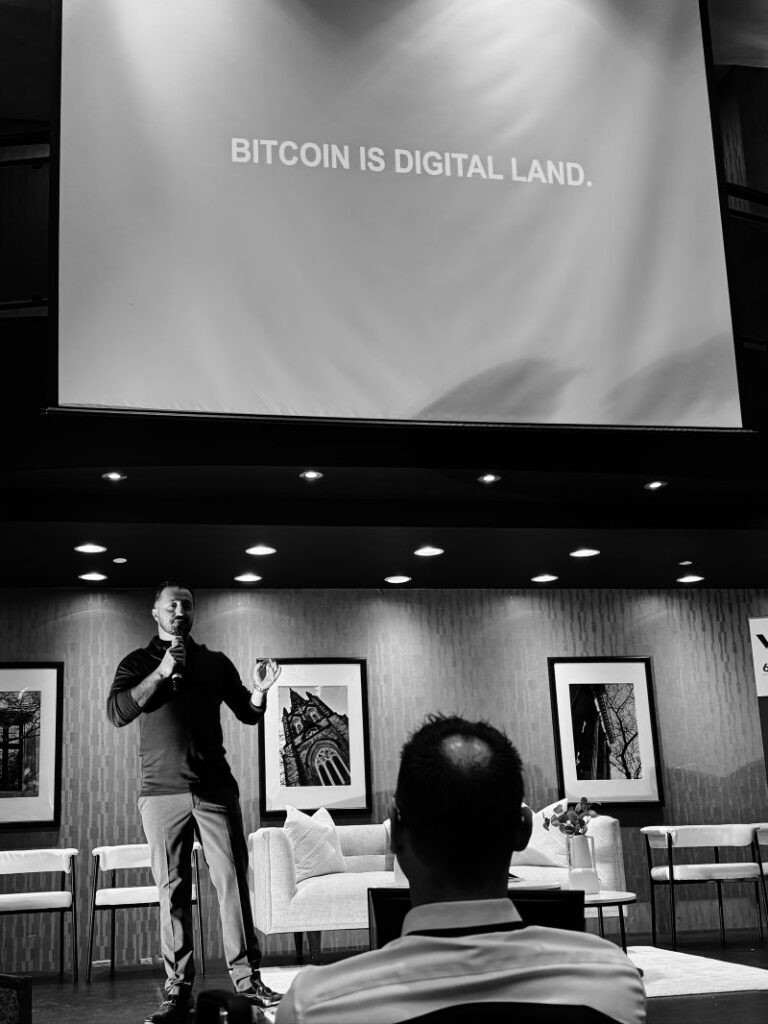
I had five minutes on stage at Vision 2026 to make one point: Bitcoin isn’t crypto. It’s digital land.
The room was 350 of the top real estate professionals in the country. People who’ve built their careers on understanding scarcity, ownership, and long-term value. People whose entire business model rests on the principle that limited supply drives demand, and that early positioning compounds into long-term wealth.
That’s exactly why Bitcoin should make sense to this audience — and exactly why most of them have ignored it.
The Frame
Bitcoin operates on the same principles real estate does.
Fixed supply: 21 million. Never more. No one can issue more of it. No central authority can change that. It’s the first asset in human history that’s actually scarce in a digital environment — where everything else can be copied or replicated infinitely.
Think of it as 21 million acres of digital land. That’s all there is. And more and more of the global economy is being built on top of it.
If you understand why land in a great location appreciates, you already understand why Bitcoin works. Same logic. Different layer.
The Reality Check
Most of the people in that room had already watched Bitcoin go up 10x or more — and decided it wasn’t for them. They’d convinced themselves they were too late.
That reaction is normal. Every person who heard about Bitcoin for the first time ignored it. I did the same thing.
The mistake isn’t missing it the first time. The mistake is doubling down on that decision now, because admitting you were wrong is uncomfortable.
Bitcoin has been around for 17 years. It has over a trillion dollars in market cap. Every major bank now holds it. At this point, dismissing it isn’t skepticism. It’s ignoring reality.
The Inevitability
Here’s what I’m certain of:
Every homeowner will own Bitcoin. Every landlord and investor will own Bitcoin. Every business owner and broker will own Bitcoin.
The only thing you control is when.
This isn’t a prediction. It’s already happening. The institutional infrastructure being built around Bitcoin — custody, lending, capital markets — is being constructed the same way the financial infrastructure was built around real estate. That’s the second wave, and it’s bigger than the first.
The first wave was just buying Bitcoin. The second wave is the entire ecosystem being built on top of it.
The Wrong Question
Most people frame this as Bitcoin or real estate. Digital or analog. New or old.
It’s not. The next decade of wealth gets built on both.
Your clients are going to hold digital land and analog land. They’re going to move capital between them. They’re going to leverage one against the other. The realtors who understand both sides are going to own that decade. The ones who don’t will be competing for the same shrinking pool of traditional buyers.
This isn’t about replacing real estate. It’s about expanding what you understand wealth-building to mean.
What to Do With This
If this perspective is new to you, here’s where to start:
Understand why 21 million matters. Understand how Bitcoin maintains its scarcity without a central authority. Understand what ownership actually looks like in this system.
You don’t need to do anything today. But you should pay attention. Because the people who built generational wealth in real estate didn’t do it by reacting to trends after they were obvious. They did it by understanding early what others figured out late.
Bitcoin is the same story. Different layer. Same playbook.
The only thing you control is when.