
How to Buy Bitcoin in Canada
Buy Bitcoin in Canada through a regulated, Bitcoin-only platform built for Canadians who want compliance, clarity, and control — no altcoins, no speculation, no confusion.
1Bitcoin.ca provides Canadians with a straightforward, regulated way to buy Bitcoin — without altcoins, trading noise, or speculative distractions.
This platform is designed for individuals who want clarity, compliance, and direct ownership of their Bitcoin.
Buy Bitcoin. Take custody. Hold on your terms.
What is Bitcoin?
Bitcoin is the world’s first decentralized digital currency. Unlike Canadian dollars, which are issued and controlled by the Bank of Canada, Bitcoin operates on a peer-to-peer network with no central authority. It was created in 2009 by an anonymous person or group using the name Satoshi Nakamoto.
Key Properties of Bitcoin?
Fixed supply: Only 21 million Bitcoin will ever exist. No government or company can print more.
Decentralized: No bank, government, or corporation controls it.
Transparent: Every transaction is recorded on a public ledger called the blockchain.
Portable: You can send Bitcoin to anyone in the world, 24/7, without a bank.
Divisible: You don’t need to buy a whole Bitcoin. You can buy as little as $20 worth (called “satoshis” — there are 100 million satoshis in one Bitcoin).
Canada was the first country in the world to approve a Bitcoin ETF, in 2021. But buying actual Bitcoin gives you true ownership — an ETF is just a financial product, not real Bitcoin.
How to Buy Bitcoin in Canada
Why Canadians Are Buying Bitcoin
Inflation hedge — Bitcoin’s fixed supply of 21 million makes it resistant to currency debasement
Portfolio diversification — Bitcoin is uncorrelated with traditional assets
Self-sovereignty — You can hold Bitcoin yourself, outside the banking system
Global access — Send value anywhere in the world, 24/7
Canada was the first country to approve a Bitcoin ETF, signaling mainstream acceptance. But buying actual Bitcoin (not an ETF) gives you true ownership and the ability to self-custody.
Methods to Buy Bitcoin in Canada
1
Canadian Bitcoin Exchanges
2
Bitcoin ATMs
Pros:
- Buy with cash
- Some require no ID for small amounts
Cons:
- High fees (often 8-15%)
- Limited locations
- Purchase limits
Best for: Small cash purchases, privacy-focused buyers
3
Peer-to-Peer (P2P)
4
Bitcoin ETFs
Pros:
- Easy to buy in TFSA/RRSP
- No wallet management
Cons:
- You don't own actual Bitcoin
- Management fees
- Can't withdraw Bitcoin
- Counterparty risk
Best for: Investors who want exposure without ownership
What FINTRAC registration means for you:
- They are required to report suspicious transactions
- You have legal recourse if something goes wrong
- The platform cannot disappear overnight without regulatory consequences
The custodial vs. non-custodial difference:
How to Choose a Bitcoin Platform in Canada
Must-Haves
2. Canadian company — Easier support, CAD deposits, and legal recourse
3. Non-custodial option — The ability to withdraw Bitcoin to your own wallet
4. Transparent fees — Know what you're paying before you buy
Red Flags
- Can't withdraw Bitcoin (only sell back)
- Hidden fees or wide spreads
- Poor reviews or scam reports
- Pushing altcoins aggressively
Why We Built 1Bitcoin.ca
We encourage you to withdraw to your own wallet
Based in Canada, for Canadians
We believe in Bitcoin, not crypto casinos
We help you understand what you're buying
How to Buy Bitcoin in Canada
The easiest way to buy Bitcoin in Canada is through a regulated Canadian Bitcoin platform like 1Bitcoin.ca. You can buy Bitcoin with Interac e-Transfer in under 10 minutes.
-
Create an Account — What to Expect
When you visit 1Bitcoin.ca, the sign-up process takes about 2 minutes. You’ll enter your email address, choose a password, and verify your phone number. No credit card required to create an account.
Tip: Use a strong, unique password and enable two-factor authentication (2FA) immediately after account creation. This protects your account from unauthorized access.
-
Verify Your Identity — Why It's Required
Identity verification is required by Canadian law under FINTRAC regulations. All legitimate Canadian Bitcoin platforms must verify their users as part of their Money Services Business (MSB) obligations.
What you’ll need:
- Government-issued photo ID (driver's licence or passport)
- A selfie holding your ID (liveness check)
- Proof of address (utility bill, bank statement dated within 3 months)
How long does it take?
Most users are verified within minutes during business hours. In some cases, manual review may take up to 24 hours. You'll receive an email notification when your account is approved.
Why this matters: FINTRAC verification protects Canadian consumers by ensuring platforms are compliant with anti-money laundering (AML) laws.
-
Fund Your Account — Interac e-Transfer Details
Interac e-Transfer is the fastest and most common funding method for Canadian Bitcoin buyers. Here's exactly how it works:
- Log into your bank's online or mobile app
- Navigate to "Send Money" or "Interac e-Transfer"
- Add the recipient details provided by 1Bitcoin.ca
- Include your unique reference code in the message field (important — this is how we match your deposit to your account)
- Send the transfer
Processing time: Most Interac e-Transfers are processed within 30–60 minutes during business hours. Some banks auto-deposit immediately.
Deposit limits: Standard Canadian banking Interac e-Transfer limits apply. For larger purchases, bank wire transfers are also accepted with no additional deposit fees.
-
Buy Bitcoin — What You'll See
Once your account is funded:
- Enter the amount in CAD you want to spend
- Review the Bitcoin quote (price is locked for a short window)
- Confirm the purchase
- Bitcoin is sent to your designated wallet address
The entire process takes seconds once your account is funded and verified.
-
Withdraw to Your Own Wallet — A Critical Step
This is the most important step for long-term Bitcoin ownership. Leaving Bitcoin on any platform introduces custodial risk — the risk that the platform is hacked, goes bankrupt, or freezes withdrawals.
To withdraw from 1Bitcoin.ca:
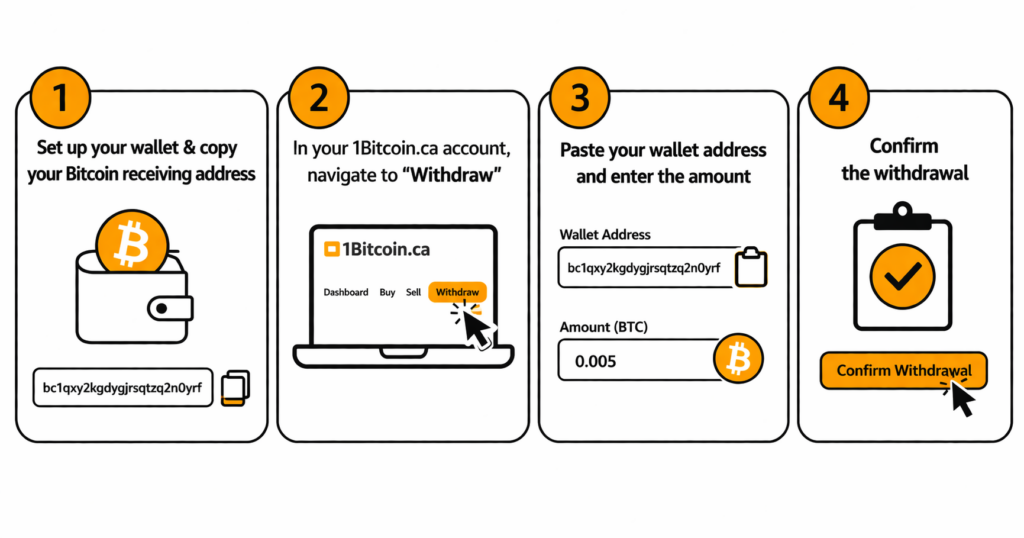
Not Your Keys, Not Your Coins
Fees: What You'll Actually Pay
Typical Fee Structure in Canada
What "zero fees" actually means:
1Bitcoin.ca Fees
We charge a transparent fee on each transaction — no hidden spreads or surprise charges. View current rates at 1bitcoin.ca/fees
Dollar-Cost Averaging: The Canadian Approach to Bitcoin
Many experienced Bitcoin investors use a strategy called dollar-cost averaging (DCA): buying a fixed amount of Bitcoin on a regular schedule, regardless of price.
Why DCA works:
– Removes the pressure of timing the market
– Reduces the impact of price volatility
– Builds a Bitcoin position gradually over time
– Creates a disciplined savings habit
Example:
Instead of trying to buy at the “right price,” you buy $100 of Bitcoin every week. Over 52 weeks, you’ve invested $5,200 and acquired Bitcoin at a variety of prices — some high, some low — averaging out to a reasonable overall cost.
Many Canadians set up recurring purchases on their favourite Bitcoin platforms and treat it like a savings account.
Bitcoin Tax in Canada
Canadian Bitcoin Taxes
The Canada Revenue Agency (CRA) treats Bitcoin as a commodity, not a currency. This has important implications for how transactions are taxed.
Taxable events:
– Selling Bitcoin for Canadian dollars → Capital gains tax applies
– Trading Bitcoin for another cryptocurrency → Taxable disposition
– Spending Bitcoin on goods or services → Taxable disposition
– Receiving Bitcoin as payment for work → Income tax applies
Non-taxable events:
– Buying Bitcoin with Canadian dollars
– Transferring Bitcoin between your own wallets
– Holding Bitcoin (no tax until you sell)
Capital gains calculation:
When you sell Bitcoin, you pay tax on 50% of your gain (the “inclusion rate” for capital gains in Canada). Your gain is the difference between what you paid and what you received.
Example: You buy 0.1 BTC for $5,000 CAD. Later, you sell it for $8,000 CAD. Your gain is $3,000. You pay tax on 50% of that gain, which is $1,500, at your marginal tax rate.
Record keeping:
Keep detailed records of:
– Date of each purchase and sale
– Amount in CAD at time of transaction
– Bitcoin amount
– Platform used
– Any fees paid
Many Canadians use crypto tax software like Koinly, CoinLedger, or TaxBit to automatically track transactions and generate CRA-compliant tax reports.
TFSA and RRSP: Bitcoin ETFs can be held in registered accounts (TFSA, RRSP, RESP). However, directly purchased Bitcoin cannot be held in these accounts. The tax advantages of registered accounts apply to ETFs only.
This is not tax advice. Consult a qualified Canadian tax professional for guidance specific to your situation.
Tax Implications
In Canada, Bitcoin is treated as a commodity by the CRA. This means:
Buying Bitcoin — No tax event
Selling Bitcoin for CAD — Capital gains tax applies
Spending Bitcoin — Treated as a disposition (taxable)
Holding Bitcoin — No tax until you sell
Keep records of all your purchases including dates, amounts, and CAD values. Many Canadians use crypto tax software to track this automatically.
This is not tax advice. Consult a tax professional for your specific situation.
Security Best Practices
Bitcoin Security in Canada
The golden rule: Not your keys, not your Bitcoin.
When you store Bitcoin on an exchange, the exchange controls the private keys — the cryptographic proof of ownership. If the exchange is hacked, goes bankrupt, or freezes withdrawals, you cannot access your Bitcoin. This happened to customers of Celsius, BlockFi, and FTX in 2022, costing Canadian investors millions.
Levels of Bitcoin security:
Level 1 — Exchange wallet (most convenient, least secure)
Leave Bitcoin on the platform after purchase. Acceptable for small amounts you plan to sell or trade soon. Not recommended for long-term storage.
Level 2 — Software wallet (mobile or desktop)
Install a Bitcoin wallet app on your phone or computer and withdraw your Bitcoin from the exchange. You control the private keys, but if your device is lost, stolen, or infected with malware, your Bitcoin could be at risk. Best practice: write down your 12-24 word seed phrase and store it safely offline.
Level 3 — Hardware wallet (most secure)
A dedicated device that stores your private keys offline. Even if your computer is hacked, your Bitcoin is safe. This is the recommended approach for any significant amount of Bitcoin. Leading options include Coldcard, Trezor, and Ledger.
Setting up a hardware wallet:
- Purchase directly from the manufacturer (never from third-party sellers)
- Initialize the device and write down your seed phrase on paper
- Store the seed phrase in a safe or fireproof location — never digitally
- Withdraw your Bitcoin from the exchange to your hardware wallet address
- Verify the first small withdrawal before moving larger amounts
Your seed phrase — the most important thing:
Your seed phrase (12 or 24 words) is the master key to your Bitcoin. Anyone who has it can access your funds. Guidelines:
– Write it on paper (never type it or photograph it)
– Store it in a fireproof, waterproof location
– Consider a metal backup plate for long-term storage
– Never share it with anyone — no legitimate service will ever ask for it
Protect Your Bitcoin
1. Use a hardware wallet for long-term storage
2. Enable 2FA on all accounts
3. Never share your seed phrase — No legitimate service will ever ask for it
4. Beware of scams — If it sounds too good to be true, it is
Common Scams to Avoid
– “Double your Bitcoin” schemes
– Fake customer support on social media
– Phishing emails mimicking exchanges
– Romance scams requesting Bitcoin payment
If anyone pressures you to buy Bitcoin urgently, it’s likely a scam.
Bitcoin Wallets
Hardware wallets (recommended for long-term storage):
Trezor — User-friendly, supports multiple cryptocurrencies
Ledger — Popular option with mobile app integration
Software wallets (for smaller amounts and frequent access):
BlueWallet — Open source, supports both on-chain and Lightning
Sparrow — Advanced features for privacy-focused users
Custodial wallets (exchange-held):
Paper wallets
Frequently Asked Questions
Is it legal to buy Bitcoin in Canada?
Yes. Bitcoin is legal to buy and own in Canada. Use a reputable Canadian service that follows applicable compliance requirements.
What's the minimum amount I can buy?
Most services let you start with as little as $20 to $50 CAD. You do not need to buy a whole bitcoin; you can buy fractions (satoshis).
How long does it take to buy Bitcoin?
With Interac e-Transfer, the full process from sign-up to owning bitcoin can often be completed in under 30 minutes.
Should I keep Bitcoin on an exchange?
For small amounts you plan to trade, leaving funds on an exchange can be convenient. For larger amounts or long-term holding, moving bitcoin to your own wallet is generally safer.
What's the best time to buy Bitcoin?
No one can time the market perfectly. Many Canadians use dollar-cost averaging (DCA), buying a fixed amount on a regular schedule regardless of price.
Do I have to pay taxes on Bitcoin?
In Canada, taxes may apply when you sell, trade, or spend bitcoin. Keep records of purchases, sales, fees, and dates so you can report properly.
Can I buy Bitcoin in my TFSA or RRSP?
You cannot directly hold Bitcoin in a TFSA or RRSP. However, Bitcoin ETFs (like the Purpose Bitcoin ETF, traded on the TSX) can be held in registered accounts. Direct Bitcoin ownership requires a separate account, but gains are still subject to capital gains tax treatment rather than income tax, which is advantageous.
What happens if 1Bitcoin.ca closes down?
Because 1Bitcoin.ca sends Bitcoin directly to your own wallet, your Bitcoin is not affected if the platform shuts down. This is the key advantage of non-custodial platforms — your Bitcoin exists on the blockchain, not on the platform’s balance sheet.
How do I know I'm getting a fair price?
You can compare the price offered by any platform against the current Bitcoin market price on sites like CoinGecko or CoinMarketCap. The difference between the market price and what you pay is the effective fee. 1Bitcoin.ca shows the total cost before you confirm, so there are no surprises.
Is Bitcoin safe to buy in Canada?
Yes, when purchased through a FINTRAC-registered platform. The risks to be aware of are: custodial risk (leaving Bitcoin on an exchange), phishing scams, and price volatility. Using a reputable Canadian platform, withdrawing to your own wallet, and understanding Bitcoin’s volatility are the key safeguards.
What is the minimum amount I can buy?
Most Canadian platforms allow purchases starting at $20–50 CAD. You don’t need to buy a whole Bitcoin — fractions called “satoshis” (there are 100 million satoshis per Bitcoin) are perfectly valid.
How long does it take to receive my Bitcoin?
After your purchase is confirmed, Bitcoin is sent to your wallet. On-chain Bitcoin transactions typically confirm within 10–60 minutes depending on the network fee paid and current network congestion. Transactions with higher fees confirm faster.
What is Bitcoin halving and does it affect me as a buyer?
Bitcoin halving is an event that occurs approximately every 4 years where the rate at which new Bitcoin is created is cut in half. The most recent halving occurred in April 2024. Halvings are significant because they reduce the supply of new Bitcoin entering the market, which historically has been associated with price increases over the following 12–18 months. As a buyer, understanding halving helps you appreciate Bitcoin’s fixed supply dynamic.
Ready to Buy Bitcoin?
Getting started is easy:
1. Create a free account at 1Bitcoin.ca — Takes 2 minutes
2. Verify your identity — Usually instant
3. Fund with Interac e-Transfer — Arrives in minutes
4. Buy Bitcoin — You’re done
Have questions? Our Canadian support team is here to help.
About 1Bitcoin.ca
1Bitcoin.ca is Canada’s Bitcoin-only platform. We help Canadians buy, sell, and understand Bitcoin — without the noise of altcoins or crypto speculation.
Founded in 2018, we’re focused on education and empowerment. Our goal isn’t just to sell you Bitcoin — it’s to help you become a confident Bitcoin holder.