Why Sovereignty Matters More Than Ever
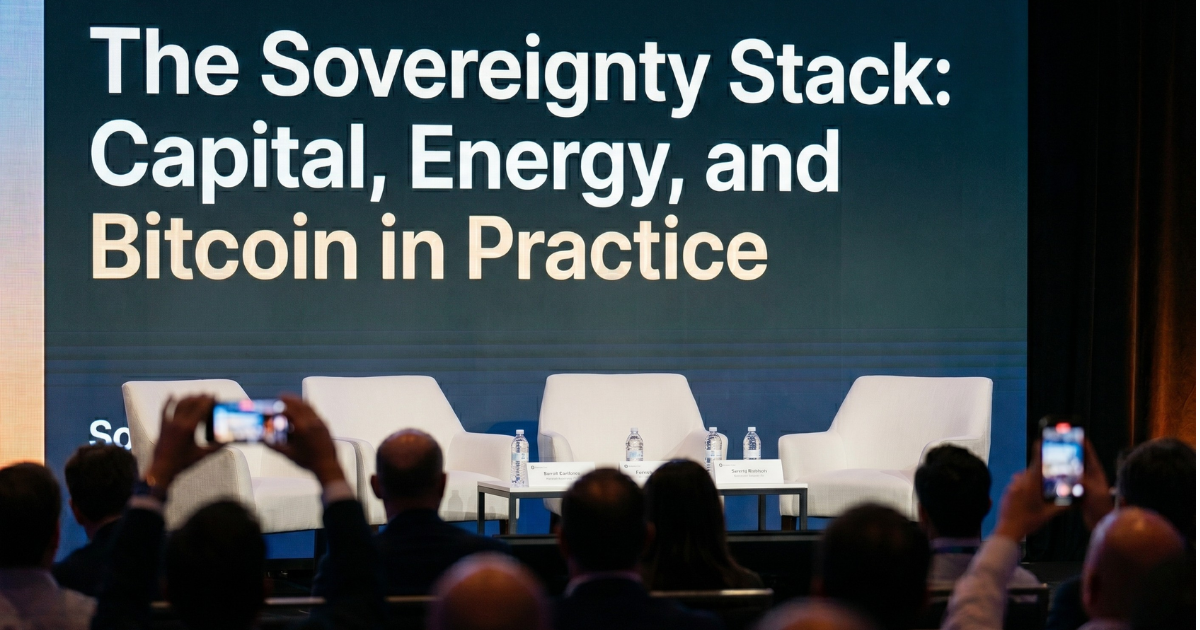
Last week, I had the opportunity to join a panel at Sovereign 2026 titled The Sovereignty Stack: Capital, Energy, and Bitcoin in Practice. The discussion brought together leaders from lending, energy innovation, and Bitcoin to explore a topic that is becoming increasingly important for entrepreneurs and business owners. As markets evolve and technology accelerates, particularly through advances in artificial intelligence, founders are being forced to think differently about the systems that support their businesses. The conversation wasn’t simply about growth. It was about resilience, adaptability, and what it takes to build companies that can endure through uncertainty.
Looking Beyond Products and Services
Many businesses spend the majority of their time focusing on products, marketing, customer acquisition, and scaling operations. While these areas are important, they often distract from a deeper question: what are the foundational systems that make growth possible in the first place? During the panel, we explored how access to capital, reliable energy, and sound monetary infrastructure are becoming critical strategic resources. These are not simply operational considerations; they are increasingly determining whether companies can grow, adapt, and remain competitive in a rapidly changing environment.
Financing Growth in a Changing Economy
One of the key perspectives shared during the discussion focused on access to capital and the challenges founders face when financing growth. Economic conditions can shift quickly, and businesses often find themselves navigating tighter lending environments, changing interest rates, and increased uncertainty. The ability to access capital while maintaining flexibility is becoming an important advantage. Growth is not only about securing funding; it is about ensuring that financing decisions support long-term resilience rather than creating new vulnerabilities.
The Impact of an AI-Driven Economy
Artificial intelligence has become the dominant business conversation of our time. Every industry is looking for ways to leverage AI to improve efficiency, reduce costs, and create new opportunities. However, AI does not exist in isolation. It requires computational power, infrastructure, and enormous amounts of energy. As a result, businesses are beginning to realize that innovation depends on much more than software. It depends on the systems that power that software. Understanding those dependencies is becoming an essential part of strategic planning.
Energy as a Strategic Resource
Energy was another important theme throughout the discussion. As demand for computing power continues to grow, reliable access to energy is becoming increasingly important for businesses across multiple industries. Advances in energy innovation are creating new opportunities for organizations to improve efficiency, reduce risk, and strengthen operational resilience. What was once viewed primarily as a utility expense is increasingly being recognized as a strategic resource that can influence both performance and long-term competitiveness.
Bitcoin as Financial Infrastructure
My contribution to the discussion focused on Bitcoin and its role within what we referred to as the sovereignty stack. Too often, Bitcoin is viewed solely through the lens of market price or investment performance. While those discussions are common, they overlook Bitcoin’s broader significance. Bitcoin represents a monetary network that allows individuals and businesses to hold value outside of traditional monetary systems. In a world where volatility and economic uncertainty have become recurring realities, the ability to preserve value and maintain financial ownership is becoming increasingly relevant.
From Infrastructure to Competitive Advantage
One of the strongest themes that emerged throughout the panel was that infrastructure decisions are becoming strategic decisions. Builders today operate in an environment where economic conditions, energy markets, and technological change can shift rapidly. The organizations that thrive will not necessarily be the ones that react the fastest; they will be the ones that prepare the best. Whether it is financing growth, securing reliable energy resources, or protecting value through sound monetary infrastructure, thoughtful decisions at the foundation level can create meaningful advantages over time.
The Common Thread
What made the discussion particularly interesting was that capital, energy, and Bitcoin all converged around the same fundamental theme: dependency. Every business relies on systems that provide access to resources, financing, and value storage. The more dependent a company becomes on systems it cannot influence or control, the more vulnerable it may be when those systems change. Sovereignty, in a practical business sense, is about understanding those dependencies and creating greater resilience wherever possible.
Final Thoughts
Participating in Sovereign 2026 reinforced an idea that continues to resonate with me: resilience is becoming one of the most important assets a business can possess. As technology continues to reshape the economy, founders must look beyond the visible layers of their companies and examine the infrastructure that supports everything else. Capital, energy, and Bitcoin may appear to be separate conversations, but together they form a framework for thinking about durability, adaptability, and long-term success. The founders who understand these systems will be better positioned to navigate volatility, protect value, and make smarter decisions in an increasingly uncertain world. That is ultimately what the Sovereignty Stack is all about.