Why Owning Your Keys Matters More Than Ever
In Bitcoin, ownership is binary.
Either you control your private keys—or you don’t actually own your bitcoin.
With traditional money, banks hold balances, approve transactions, and ultimately decide what you can and can’t do with your funds. Bitcoin was designed to change that dynamic entirely. When held properly, Bitcoin allows individuals to become their own bank.
For many Canadians, this journey begins right after they buy bitcoin in Canada and realize that purchasing bitcoin is only the first step. Custody is what defines real ownership.
Before moving your coins to self-custody, make sure you understand how to buy Bitcoin in Canada safely from a trusted platform.
Ownership in Bitcoin Is Binary
There’s a simple rule in Bitcoin:
If you don’t control your keys, you don’t control your money.
Your private keys are the cryptographic proof that grants access to your bitcoin. If a third party controls those keys—whether it’s an exchange, brokerage, institution, or custodial service—you are relying on permission rather than ownership.
The lessons of the past several years remain relevant. Exchange failures, withdrawal freezes, insolvencies, and account restrictions demonstrated a fundamental truth: custody matters.
True Bitcoin ownership means holding money that cannot be frozen, diluted, censored, or restricted by another party.
What Is Self-Custody?
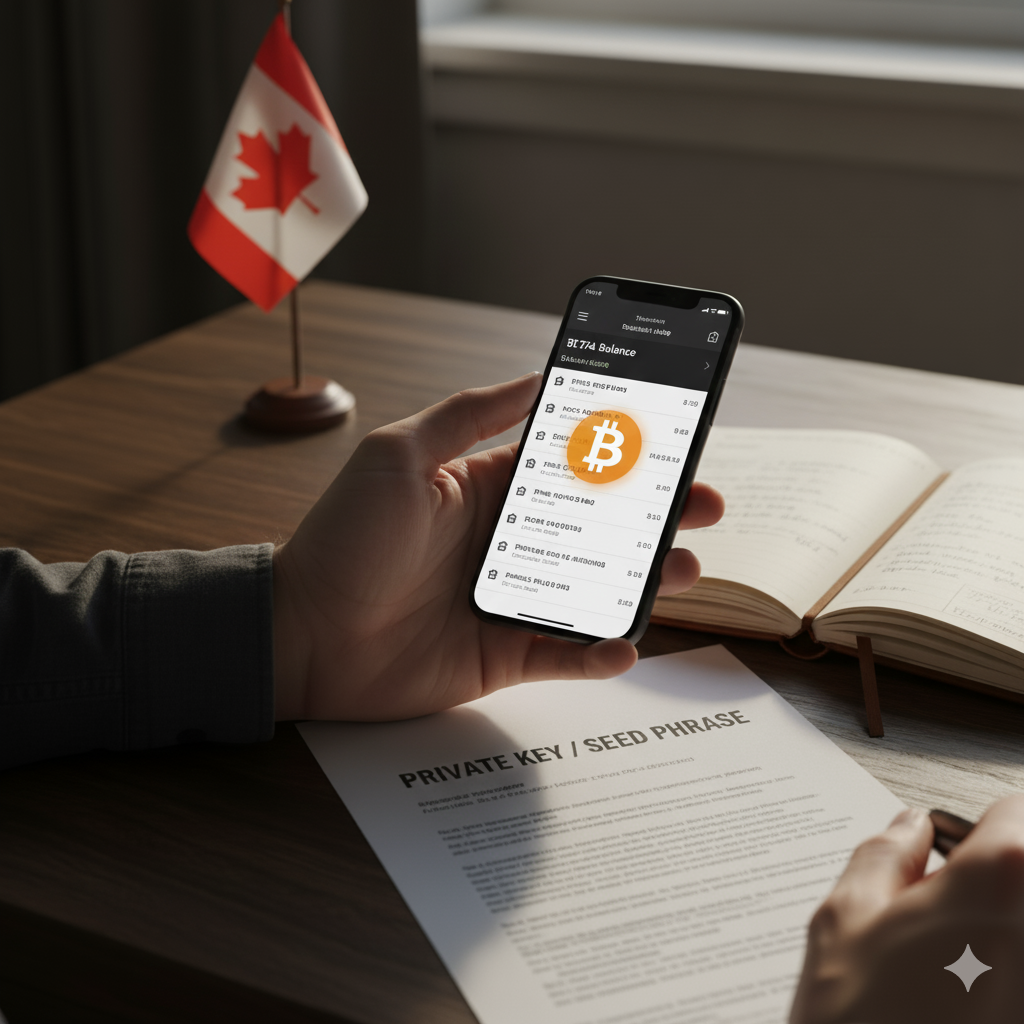
Self-custody means storing your bitcoin in a wallet where only you control the private keys.
There is:
- No custodian
- No intermediary
- No gatekeeper
You manage access to your bitcoin directly.
This is not an advanced feature of Bitcoin. It is Bitcoin’s original design.
For individuals holding meaningful value, self-custody isn’t optional. It’s foundational. This is especially true for long-term allocators and families who approach Bitcoin as generational wealth, similar to those served by Bitcoin for High Net Worth Canadians.
Why Self-Custody Matters More Than Ever
1. Counterparty Risk Never Disappears
The names change, but the risk remains the same.
Every time bitcoin is left on a third-party platform, users assume risks they cannot fully control, including:
- Insolvency
- Operational failures
- Withdrawal restrictions
- Cybersecurity breaches
- Regulatory actions
Self-custody removes these counterparty risks by ensuring that ownership remains with the holder rather than a service provider.
2. Bitcoin Adoption Is Accelerating
Bitcoin has become increasingly integrated into the global financial system.
Public companies continue to add bitcoin to their balance sheets. Institutional investment products have expanded. Governments and regulators have developed clearer frameworks around Bitcoin ownership and reporting.
As adoption grows, so does the importance of understanding the difference between exposure to Bitcoin and actual ownership of Bitcoin.
Self-custody allows individuals and businesses to remain in control regardless of policy shifts. This principle is increasingly relevant not just for individuals, but for companies exploring Corporate Treasury Bitcoin Canada strategies where custody risk is non-negotiable.
3. Scams and Social Engineering Are Becoming More Sophisticated
The biggest threat to many Bitcoin holders is no longer technology—it’s deception.
In 2026, common threats include:
- AI-generated phishing attacks
- Fake wallet applications
- Fraudulent customer support impersonations
- Malicious browser extensions
- Seed phrase theft schemes
The strongest defense remains education and proper self-custody practices.
No legitimate wallet provider, exchange, or Bitcoin company will ever need your recovery phrase or private keys.
4. Bitcoin Is Increasingly Viewed as Long-Term Savings
More Canadians now view Bitcoin as a long-term savings asset rather than a speculative trade.
Whether accumulating for retirement, future generations, business reserves, or wealth preservation, self-custody becomes increasingly important as holdings grow.
Most people would not leave their life savings in someone else’s pocket.
Bitcoin should be treated with the same level of care and responsibility.
5. Financial Sovereignty Matters in an Uncertain World
Economic uncertainty, inflation concerns, banking instability, and geopolitical events continue to remind people that financial systems can change quickly.
Bitcoin offers an alternative built on open-source software, mathematical rules, and individual ownership.
Self-custody is the mechanism that makes that sovereignty possible.
Common Self-Custody Mistakes to Avoid
New Bitcoin owners often make avoidable mistakes, including:
- Taking photos of recovery phrases
- Storing seed phrases in cloud storage
- Sharing wallet information with others
- Downloading wallets from unofficial sources
- Skipping backup procedures
- Transferring large amounts before understanding the process
A small amount of education can prevent costly errors.
How to Practice Self-Custody Safely
Self-custody does not mean taking unnecessary risks. It means taking responsibility.
Best practices include:
- Using reputable Bitcoin-only wallets
- Learning how private keys and recovery phrases work
- Storing backups offline
- Keeping recovery phrases secure and private
- Starting with small amounts while learning
- Using hardware wallets for larger holdings
- Periodically reviewing your security practices
Many businesses apply the same layered approach—hot wallets for operations, cold storage for reserves—mirroring models used in Bitcoin for Businesses Canada.
Final Thought
Self-custody is more than a Bitcoin feature.
It’s a mindset.
It says:
“I take responsibility for my money.”
That responsibility requires learning, patience, and discipline.
In return, Bitcoin offers something increasingly rare in the modern financial world: direct ownership.
No approvals.
No intermediaries.
No dependency on a third party.
In Bitcoin, self-custody isn’t an optional upgrade.
It’s the foundation of ownership.
And when the time comes, here’s how to sell Bitcoin in Canada securely while maintaining control of your funds throughout the process.