Bitcoin vs Bitcoin ETFs in Canada
Canadians have two main ways to get Bitcoin exposure: buying actual Bitcoin or buying a Bitcoin ETF. While both track Bitcoin’s price, they work very differently in terms of ownership, custody, fees, tax treatment, and control.
This guide breaks down the key differences between owning Bitcoin directly and holding a Bitcoin ETF, when each option makes sense, and whether you can use both as part of a portfolio allocation strategy.
What Is a Bitcoin ETF?
A Bitcoin ETF (Exchange-Traded Fund) is an investment product that tracks the price of Bitcoin without requiring you to own the actual asset. You buy shares of the ETF through a traditional brokerage account, just like buying stocks.
Canadian Bitcoin ETFs launched in February 2021, making Canada one of the first countries to offer regulated Bitcoin ETF products. Popular Canadian Bitcoin ETFs include:
- Purpose Bitcoin ETF (BTCC)
- Fidelity Advantage Bitcoin ETF (FBTC)
- CI Galaxy Bitcoin ETF (BTCX)
- Evolve Bitcoin ETF (EBIT)
These ETFs are traded on the Toronto Stock Exchange (TSX) and hold actual Bitcoin in custody on behalf of investors.
What Is Direct Bitcoin Ownership?
Direct Bitcoin ownership means you buy Bitcoin from a platform or broker and control it yourself by holding it in your own wallet. You own the private keys, which means you have full custody and control over the Bitcoin.
When you own Bitcoin directly:
- You can send it to anyone, anywhere, at any time
- You control the private keys (the cryptographic proof of ownership)
- No intermediary can freeze, restrict, or confiscate your Bitcoin
- You are responsible for securing and backing up your wallet
For Canadians looking to buy Bitcoin in Canada and take full ownership, direct purchase means complete control over the asset without relying on a fund manager or custodian.
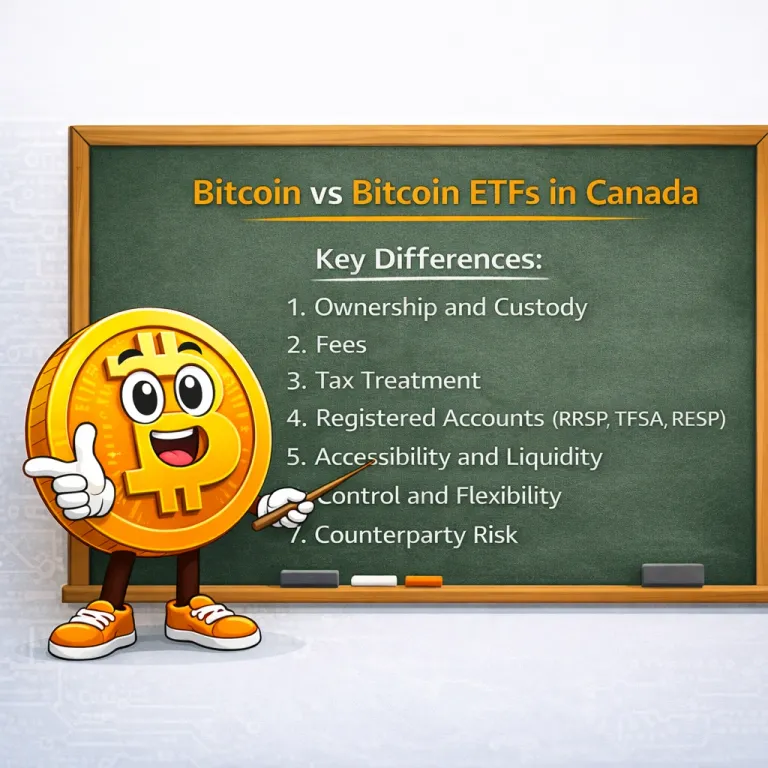
Key Differences: Bitcoin vs Bitcoin ETFs
1. Ownership and Custody
Bitcoin (Direct Ownership):
- You own the Bitcoin itself
- You control the private keys
- Bitcoin is held in your wallet (software or hardware)
- No third party can access, freeze, or restrict your Bitcoin
Bitcoin ETF:
- You own shares in a fund that holds Bitcoin
- The ETF provider controls the Bitcoin
- Bitcoin is held by a third-party custodian
- You have no access to the underlying Bitcoin; you can only sell ETF shares
Key difference: With Bitcoin, you have sovereignty. With an ETF, you have exposure to Bitcoin’s price but no control over the asset.
2. Fees
Bitcoin (Direct Ownership):
- Platform fee: 0.5%–2% on purchase (one-time)
- Network fee: $1–$10 per withdrawal (one-time)
- No ongoing fees after purchase
- No management fees
Bitcoin ETF:
- Management fee (MER): 0.4%–1% annually
- Brokerage commission: $5–$10 per trade (varies by broker)
- Ongoing annual fees as long as you hold
Example cost comparison (5-year holding period, $10,000 initial investment):
Direct Bitcoin ownership:
- Purchase fee (1%): $100
- Withdrawal fee: $10
- Total cost over 5 years: $110
Bitcoin ETF (0.75% MER):
- Year 1 MER: $75
- Year 2 MER: $75 (assumes flat Bitcoin price for simplicity)
- Year 3 MER: $75
- Year 4 MER: $75
- Year 5 MER: $75
- Total cost over 5 years: $375
Over time, the ETF’s annual management fee compounds and significantly exceeds the one-time cost of buying Bitcoin directly.
3. Tax Treatment
Bitcoin (Direct Ownership):
- Buying Bitcoin: Not taxable
- Holding Bitcoin: Not taxable
- Selling Bitcoin: Taxable as capital gains (50% inclusion rate)
- Using Bitcoin for purchases: Taxable as capital gains
Bitcoin ETF:
- Buying ETF shares: Not taxable
- Holding ETF shares: Not taxable
- Selling ETF shares: Taxable as capital gains (50% inclusion rate)
- Dividends or distributions (if any): May be taxable as income
Key difference: Tax treatment is similar for both when held in a non-registered account. The main difference is in registered accounts (see below).
4. Registered Accounts (RRSP, TFSA, RESP)
Bitcoin (Direct Ownership):
- Cannot be held in an RRSP, TFSA, or RESP
- Must be held in a personal wallet or taxable account
- Capital gains are taxable when sold
Bitcoin ETF:
- Can be held in an RRSP, TFSA, or RESP
- Growth inside a TFSA is tax-free
- Growth inside an RRSP is tax-deferred until withdrawal
- Contributions to an RRSP are tax-deductible
Key difference: If you want Bitcoin exposure inside a registered account for tax advantages, an ETF is the only option. You cannot hold actual Bitcoin in an RRSP or TFSA.
This is the primary reason many Canadians use Bitcoin ETFs—they provide tax-sheltered Bitcoin exposure.
5. Accessibility and Liquidity
Bitcoin (Direct Ownership):
- Buy from a Bitcoin platform or broker
- Requires account verification (1–24 hours typically)
- Can send Bitcoin 24/7, including weekends and holidays
- Settled in 10–60 minutes on the Bitcoin network
- No trading hours—Bitcoin operates 24/7/365
Bitcoin ETF:
- Buy through any Canadian brokerage account
- No special verification beyond standard brokerage KYC
- Can only trade during TSX hours (9:30 AM–4 PM EST, Monday–Friday)
- Settled like any stock (T+2 settlement in Canada)
- Cannot access Bitcoin outside market hours
Key difference: Direct Bitcoin ownership gives you 24/7 access and control. ETFs are limited to stock market hours.
6. Control and Flexibility
Bitcoin (Direct Ownership):
- You can send Bitcoin to anyone instantly
- You can use Bitcoin to pay for goods or services (where accepted)
- You can move Bitcoin across borders without intermediaries
- You can choose your custody method (hot wallet, cold storage, multisig)
- No counterparty can restrict or freeze your Bitcoin
Bitcoin ETF:
- You cannot send or spend the underlying Bitcoin
- You can only buy or sell ETF shares
- ETF shares cannot be transferred outside the Canadian financial system
- The custodian controls the Bitcoin; you trust the ETF provider
- Your brokerage or the ETF provider could freeze or restrict your account
Key difference: Bitcoin offers full financial sovereignty. ETFs offer price exposure within the traditional financial system.
7. Counterparty Risk
Bitcoin (Direct Ownership):
- No counterparty risk if held in self-custody
- Platform risk only during the purchase process (eliminated once withdrawn to your wallet)
- You are responsible for securing your private keys
Bitcoin ETF:
- Counterparty risk with the ETF provider
- Counterparty risk with the custodian holding the Bitcoin
- Counterparty risk with your brokerage
- If any of these entities fail, freeze accounts, or are hacked, you may lose access
Key difference: Self-custodied Bitcoin eliminates counterparty risk. ETFs introduce multiple points of counterparty exposure.
When Bitcoin ETFs Make Sense
Despite the trade-offs, Bitcoin ETFs are the right choice in certain situations:
1. You Want Bitcoin in a Registered Account
If you want Bitcoin exposure inside an RRSP or TFSA for tax advantages, an ETF is the only option.
Example:
- You have $50,000 of unused TFSA contribution room
- You buy a Bitcoin ETF inside your TFSA
- If Bitcoin appreciates to $150,000, the $100,000 gain is tax-free
This tax advantage can outweigh the ETF’s management fee over long periods.
2. You Don’t Want to Manage Custody
Some investors prefer not to manage private keys, wallet backups, or hardware devices. ETFs eliminate the need for self-custody.
Trade-off: You give up control and introduce counterparty risk in exchange for convenience.
3. You Already Have a Brokerage Account
If you’re comfortable with stocks and already have a brokerage account, buying a Bitcoin ETF is simpler than setting up a new Bitcoin platform account.
4. You Want Simplicity for Small Allocations
For small Bitcoin allocations (under $5,000) where self-custody setup feels like overkill, an ETF provides easy exposure without the need to learn wallet management.
When Direct Bitcoin Ownership Makes Sense
Direct Bitcoin ownership is the better choice when:
1. You Want Full Control and Sovereignty
If the goal is financial sovereignty—removing reliance on banks, custodians, and intermediaries—only direct ownership achieves this.
2. You’re Holding Long-Term (5+ Years)
The longer you hold, the more ETF fees compound. Over a decade, ETF management fees can consume several percentage points of your investment.
Example (10-year hold, $50,000 investment, 0.75% MER):
- ETF fees over 10 years: ~$3,750 (assumes flat Bitcoin price)
- Direct Bitcoin fees: ~$500 (one-time purchase and withdrawal)
Direct ownership saves ~$3,250 over 10 years.
3. You Want to Use Bitcoin (Not Just Hold It)
If you plan to send Bitcoin, use it for payments, or move it internationally, you need actual Bitcoin. ETF shares cannot be spent or transferred outside the financial system.
4. You Want 24/7 Access
Bitcoin operates continuously. If you want the ability to buy, sell, or move Bitcoin outside stock market hours, direct ownership is required.
5. You Want to Eliminate Counterparty Risk
For large holdings or generational wealth, self-custody removes the risk of custodian failure, brokerage freezes, or regulatory seizure.
Can You Use Both?
Yes. Many Canadians use both Bitcoin and Bitcoin ETFs as part of a diversified portfolio allocation strategy.
Example allocation:
- TFSA/RRSP: Bitcoin ETF (for tax-advantaged exposure)
- Personal wallet: Direct Bitcoin ownership (for sovereignty and long-term holding)
This approach combines the tax benefits of ETFs with the control and low ongoing costs of direct ownership.
Allocation Strategy
Conservative Bitcoin exposure (5%–10% of portfolio):
- Hold in TFSA/RRSP via Bitcoin ETF
- Maximize tax efficiency
Moderate Bitcoin exposure (10%–25% of portfolio):
- Hold 50% in TFSA/RRSP via Bitcoin ETF
- Hold 50% in self-custody for sovereignty
High Bitcoin conviction (25%+ of portfolio):
- Hold small allocation in TFSA/RRSP via Bitcoin ETF (maximize tax-free room)
- Hold majority in self-custody to minimize fees and counterparty risk
The right mix depends on your tax situation, risk tolerance, and conviction in Bitcoin as a long-term asset.
Summary: Key Trade-Offs
| Factor | Direct Bitcoin Ownership | Bitcoin ETF |
|---|---|---|
| Ownership | You own the Bitcoin | You own shares in a fund |
| Custody | Self-custody (you control keys) | Third-party custody |
| Fees | One-time (~1%) | Annual (~0.5%–1%) |
| Tax accounts | Cannot hold in RRSP/TFSA | Can hold in RRSP/TFSA |
| Access | 24/7/365 | Market hours only |
| Control | Full sovereignty | No control over underlying Bitcoin |
| Counterparty risk | None (self-custody) | ETF provider, custodian, brokerage |
| Flexibility | Can send, spend, move globally | Can only buy/sell shares |
| Setup complexity | Moderate (account + wallet) | Low (just brokerage) |
Which Should You Choose?
Choose a Bitcoin ETF if:
- You want Bitcoin exposure in a TFSA or RRSP
- You don’t want to manage private keys or wallets
- You’re comfortable with counterparty risk
- You prefer simplicity over sovereignty
Choose direct Bitcoin ownership if:
- You want full control and financial sovereignty
- You’re holding long-term and want to minimize fees
- You want 24/7 access and the ability to move Bitcoin freely
- You’re willing to learn wallet management and self-custody
Use both if:
- You want tax-advantaged exposure (ETF in RRSP/TFSA)
- You also want sovereignty and long-term holdings (direct ownership in personal wallet)
For Canadians building a serious Bitcoin position, understanding the difference between price exposure (ETF) and actual ownership (direct Bitcoin) is critical. ETFs provide convenience and tax advantages. Direct ownership provides control, sovereignty, and long-term cost efficiency.
Both have a place in a well-structured portfolio. The key is understanding what you’re getting with each option and choosing based on your goals, time horizon, and comfort with self-custody.
If you’re ready to own Bitcoin directly and take full custody, the process is straightforward, compliant, and accessible through regulated Canadian platforms.