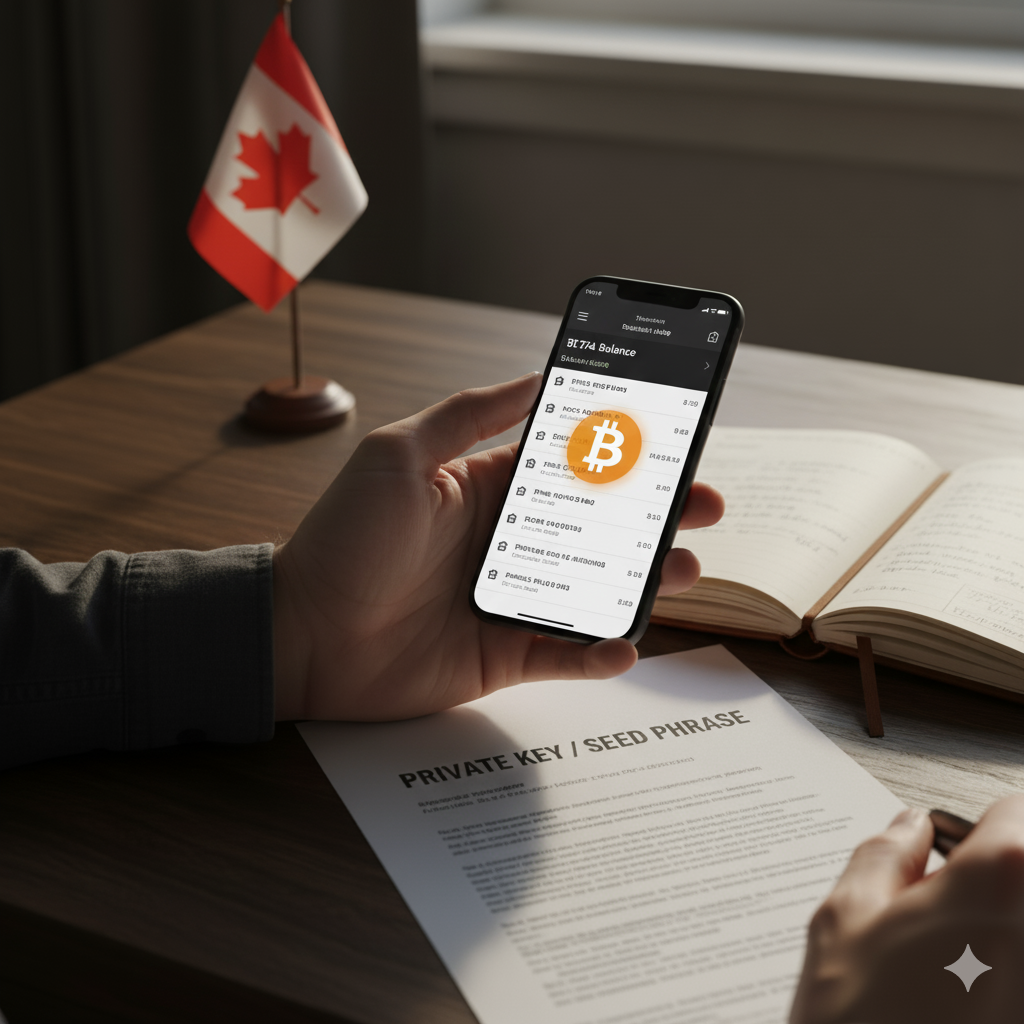
Why Owning Your Keys Matters More Than Ever
In Bitcoin, ownership is binary.
Either you control your private keys—or you don’t actually own your bitcoin.
With traditional money, banks hold balances, approve transactions, and ultimately decide what you can and can’t do with your funds. Bitcoin was designed to change that dynamic entirely. When held properly, Bitcoin allows individuals to become their own bank. For many Canadians, this journey begins right after they buy bitcoin in Canada and realize that purchasing is only the first step—custody is what defines real ownership.
Before moving your coins to self-custody, make sure you understand how to buy Bitcoin in Canada safely from a trusted platform.
Ownership in Bitcoin Is Binary
There’s a simple rule in Bitcoin:
If you don’t control your keys, you don’t control your money.
Your private key is the cryptographic proof that gives access to your bitcoin. If a third party controls it—an exchange, platform, or institution—you’re relying on permission, not ownership.
Recent years have made this painfully clear. Exchange failures, frozen accounts, and platform collapses weren’t anomalies—they were warnings. True ownership means holding money that cannot be frozen, seized, or restricted.
What Is Self-Custody?
Self-custody means storing your own bitcoin using a wallet that only you control.
There is:
- No custodian
- No intermediary
- No gatekeeper
You manage your private keys directly. This isn’t an advanced feature—it’s Bitcoin’s default design.
For individuals holding meaningful value, self-custody isn’t optional. It’s foundational. This is especially true for long-term allocators and families who approach Bitcoin as generational wealth, similar to those served by Bitcoin for High Net Worth Canadians.
Why Self-Custody Matters More Than Ever
1. Exchanges Still Fail
FTX. Celsius. Quadriga.
These weren’t edge cases. They were reminders of what happens when custody is outsourced. Leaving bitcoin on a platform exposes users to insolvency, fraud, withdrawal halts, and regulatory freezes.
Self-custody eliminates these risks entirely.
2. Regulation Is Increasing
Governments around the world continue to tighten rules around digital assets. Platforms adapt—or shut down—with little warning.
Self-custody allows individuals and businesses to remain in control regardless of policy shifts. This principle is increasingly relevant not just for individuals, but for companies exploring Corporate Treasury Bitcoin Canada strategies where custody risk is non-negotiable.
3. Scams Are Getting Smarter
In 2025, scams are more convincing than ever:
- Fake wallet updates
- Phishing emails
- Wallet drainers
The strongest defense is understanding custody and never sharing private keys.
4. Bitcoin Is Now Long-Term Wealth
Bitcoin is no longer just an experiment. For many Canadians, it represents long-term savings or future purchasing power.
If Bitcoin is meaningful, custody becomes critical. Would you trust someone else with your life savings? That question sits at the heart of self-custody.
How to Practice Self-Custody Safely
Self-custody doesn’t mean recklessness—it means responsibility.
Best practices include:
- Using reputable wallets
- Backing up recovery phrases offline
- Never sharing private keys
- Starting with small amounts
- Continuously improving security habits
Many businesses apply the same layered approach—hot wallets for operations, cold storage for reserves—mirroring models used in Bitcoin for Businesses Canada.
Final Thought
Self-custody isn’t just a Bitcoin feature—it’s a mindset.
It says:
“I take responsibility for my money.”
That responsibility requires learning and care—but it also delivers something increasingly rare in modern finance: control.
In Bitcoin, control isn’t optional.
It’s the point.
And when the time comes, here’s how to sell Bitcoin in Canada securely without giving up control of your funds.