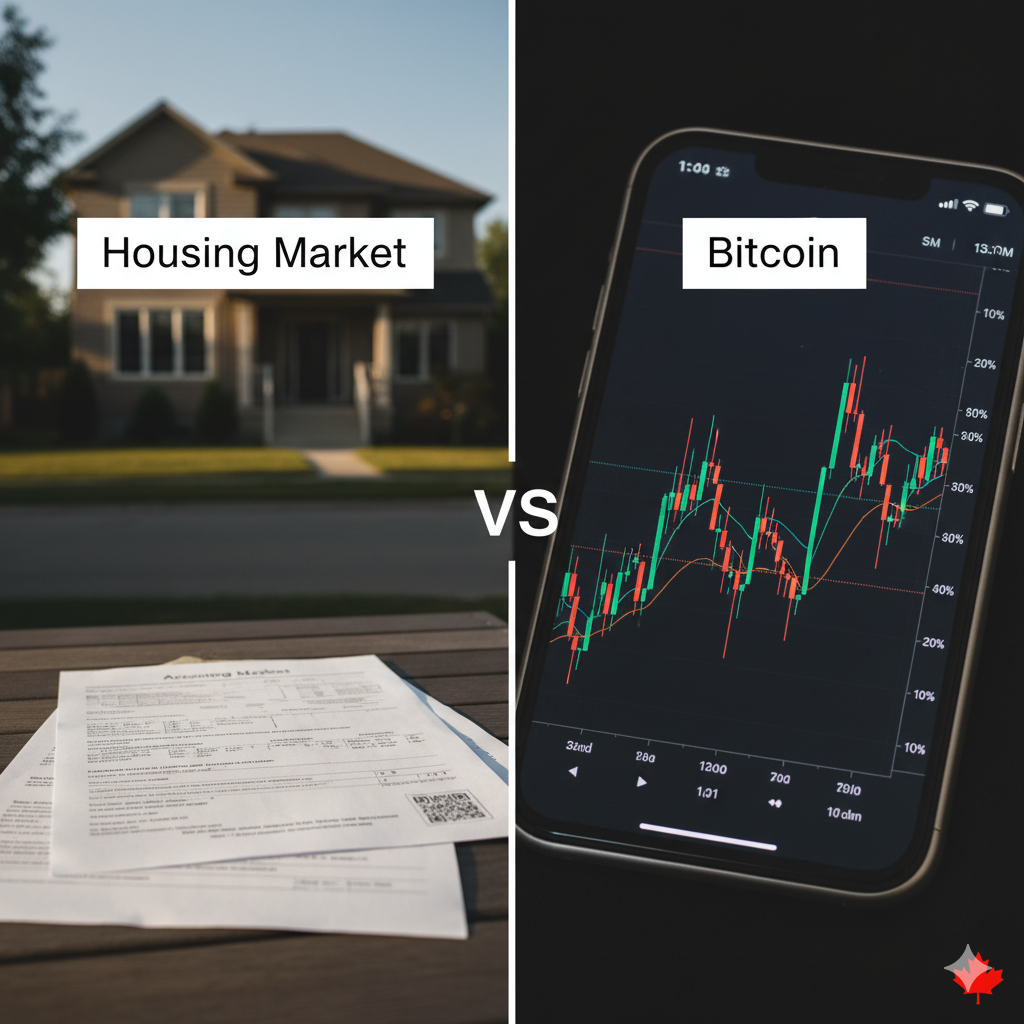
The Canadian Housing Market vs. Bitcoin
A 10-Year Wealth Comparison
September 12, 2025 – 4 min read
For decades, buying a home has been Canada’s default wealth-building strategy. Real estate wasn’t just shelter—it was a retirement plan, an investment, and often the largest source of net worth.
Over the past ten years, however, another asset has entered the conversation: Bitcoin.
This article compares Canadian housing and Bitcoin over the last decade—not to crown a winner, but to understand risk, costs, liquidity, and long-term trade-offs. For Canadians exploring alternatives beyond property, this often starts with learning how to Buy Bitcoin in Canada in a direct, non-custodial way.
The Setup: Two Canadian Investors (2015–2025)
To keep the comparison grounded, imagine two hypothetical Canadians starting in 2015.
Investor A: Housing
- Buys a representative Canadian home
- Holds it for ten years
- Pays mortgage interest, property taxes, insurance, maintenance, and transaction costs
Investor B: Bitcoin
- Buys and holds Bitcoin over the same period
- Uses self-custody
- Does not trade, leverage, or attempt to time the market
Both investors stay invested through volatility. This mirrors how most real people actually invest.
Housing Returns: Strong, but Not Free
Canadian real estate delivered strong headline returns over the past decade, particularly in major cities. But price appreciation alone doesn’t reflect true performance.
Housing comes with ongoing costs:
- Mortgage interest
- Property taxes
- Insurance
- Maintenance and repairs
- Legal and closing fees
These expenses quietly reduce net returns. Housing also concentrates risk—one property, one city, one regulatory environment. For many Canadians, that concentration worked, but it wasn’t stress-free.
Bitcoin Returns: Volatile, but Asymmetric
Over the same period, Bitcoin experienced sharp drawdowns followed by powerful recoveries. Despite extreme volatility, long-term holders who simply held through cycles saw substantial appreciation.
Key characteristics shaping Bitcoin’s performance:
- Fixed supply of 21 million
- Global, 24/7 liquidity
- No carrying costs
- No geographic concentration
Bitcoin’s risk profile isn’t lower—it’s different. That difference is why Bitcoin increasingly attracts investors focused on asymmetrical upside, including those working with Bitcoin for High Net Worth Canadians.
Dollar-Cost Averaging vs. Lump Sums
Most Canadians don’t invest perfectly. They buy gradually, invest from paycheques, and adjust over time.
In housing, this means building equity slowly in a single, illiquid asset.
In Bitcoin, it often means dollar-cost averaging—buying small amounts over time, especially during downturns.
This approach reduces timing risk and helps investors learn before committing more capital.
Liquidity and Flexibility
Liquidity is where the contrast becomes clear.
Housing
- Takes weeks or months to sell
- High transaction costs
- Dependent on credit conditions
Bitcoin
- Can be moved or sold globally, anytime
- No intermediaries required
- Fractional ownership allows flexibility
Liquidity doesn’t make one asset “better,” but it dramatically changes how risk is managed—especially during economic stress. This flexibility has also enabled new use cases such as Bitcoin for Real Estate Canada, where Bitcoin itself becomes a settlement tool.
Risk Looks Different — Not Smaller
Both assets carry risk, but of different kinds.
Housing risk
- Interest-rate shocks
- Local market downturns
- Regulatory and tax changes
Bitcoin risk
- Price volatility
- Regulatory uncertainty
- Custody mistakes
For Bitcoin holders, the biggest risk isn’t price—it’s improper storage. This is why businesses and sophisticated investors emphasize custody planning and often explore Corporate Treasury Bitcoin Canada strategies when allocations grow meaningful.
The 2025–2030 Outlook
Looking ahead, both assets face tailwinds and headwinds.
Housing
- Affordability remains strained
- Rates and supply constraints matter
- Returns may normalize
Bitcoin
- Volatility will persist
- Supply issuance continues to decline
- Adoption and financial literacy keep expanding
Neither path is guaranteed. Diversification across fundamentally different assets has historically reduced risk.
So What Should a Canadian Do?
This comparison isn’t an argument to sell your home—or to go all-in on Bitcoin.
It’s a case for balance.
For many Canadians, a thoughtful approach looks like:
- Keeping the home that fits your life
- Reducing concentration risk where possible
- Adding assets with different risk drivers
- Learning before allocating
A measured Bitcoin allocation, held long term and stored securely, can complement real estate rather than replace it.
Final Thought
For decades, Canadian wealth was almost synonymous with housing. The last ten years introduced a new variable.
Bitcoin doesn’t replace real estate—but it challenges the idea that one asset should carry all the weight.
Understanding the differences matters more than picking sides.